Ethiopia is changing how businesses issue invoices. Under the Ministry of Revenues' Electronic Invoicing System Administration Directive, an invoice is no longer just a document you print and hand over. It is a record that the Ministry's system registers at the moment of sale.
If you run a business in Ethiopia, this affects you sooner or later. This guide explains what the rules say, in plain language, and what you can do today.
What is an e-invoice?
An e-invoice is an invoice issued through sales registration software that the Ministry of Revenues has approved. It has the same legal weight as a paper invoice.
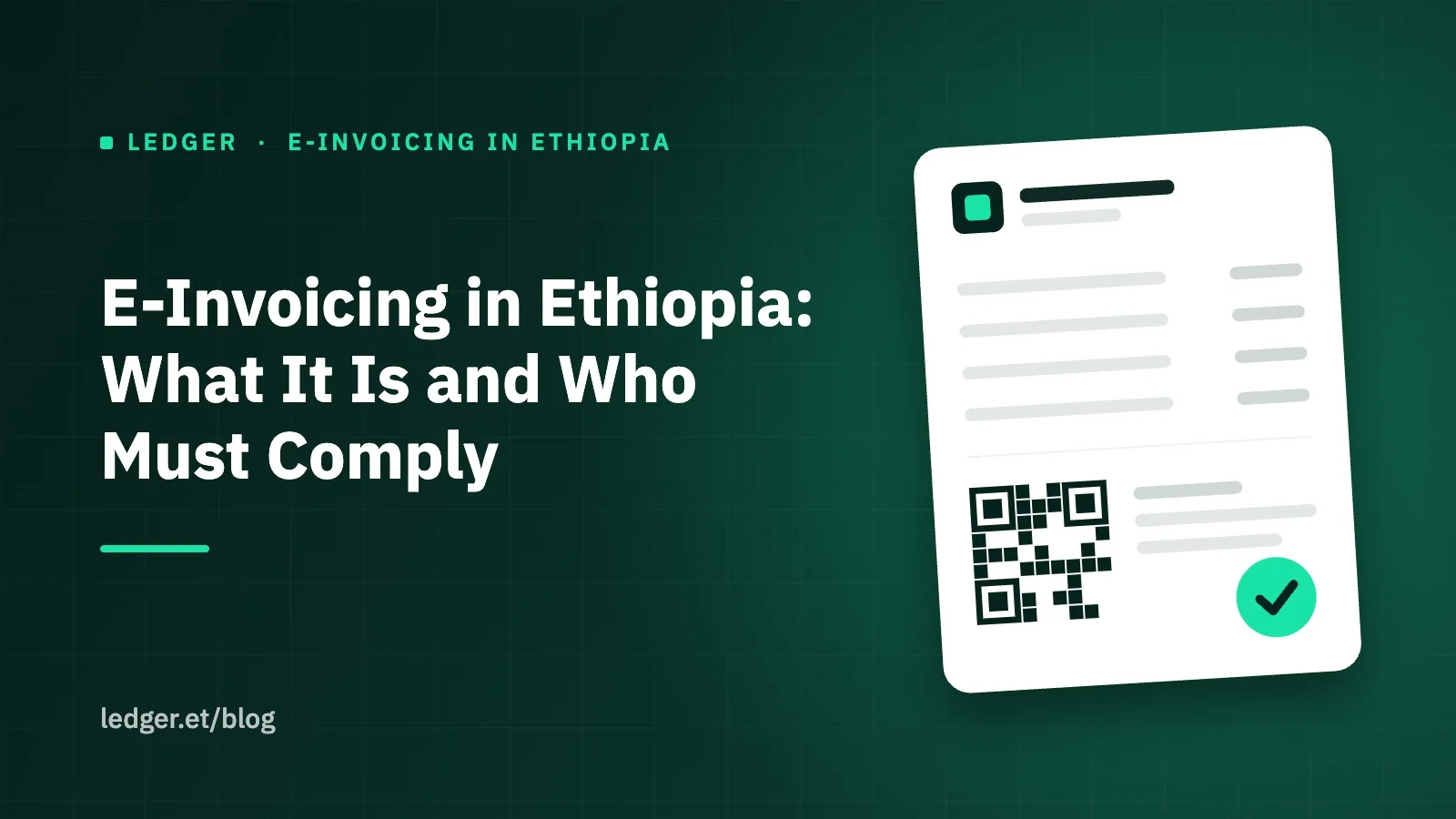
The difference is in how it is created. Before the invoice reaches your customer, your software sends the transaction to the Ministry's Electronic Invoice Registration System. The system checks it and sends back a registration number and a QR code.
On an invoice, that number is the Invoice Registration Number (IRN); on a receipt, it is a receipt number (RRN).
Only then is the invoice valid. Anyone holding it can scan the QR code and check that it is genuine.
Which law introduced it?
The rules are set out in Directive No. 1142, issued by the Ministry of Revenues in mid-2026. You will see it written two ways: 1142/2018 in the Ethiopian calendar and 1142/2026 in the Gregorian calendar. They are the same directive.
It replaces the earlier, much shorter rules on sales registration software and builds on VAT Proclamation No. 1341/2024.
Who must comply?
The directive makes an approved sales registration system mandatory for taxpayers who are required to keep books of account. It also covers the companies that supply the technology: software suppliers, software-as-a-service (SaaS) providers, businesses that build their own invoicing system, and e-commerce and digital marketplace operators.
When does it become mandatory?
This is the point where many articles online get it wrong, so we will be precise.
The directive is in force, but it does not give one start date for every business. It says the obligation applies according to a schedule issued by the Ministry. Rollout is phased, and reports indicate that large taxpayers and VAT-registered businesses come first, with a reported target of large taxpayers by the end of December 2026.
At the time of writing (November 2026), check the Ministry of Revenues' own announcements, or ask your tax office, for the date that applies to your business. Do not rely on a date you read on social media.
What happens if the internet goes down?
The directive allows manual invoicing during temporary system failures. Those transactions must then be uploaded to the Ministry's system within a short, fixed window once the connection returns, reported as 72 hours. A good provider handles this for you with an offline queue.
What should you do now?
You do not need to wait for your deadline. Three steps put you ahead:
Confirm with your accountant whether you are required to keep books of account.
Look at how you invoice today: paper pads, Excel, a cash register machine or accounting software.
Choose a provider approved by the Ministry and run it alongside your current process before it becomes compulsory.
Next in this series: how to move from paper receipts to e-invoices, step by step.
How Ledger helps
Ledger Technology PLC is listed by the Ministry of Revenues as an approved provider of sales registration SaaS under Directive No. 1142/2018 E.C. You issue compliant e-invoices from your computer or phone, and each one is registered with the Ministry automatically.
Want to see it working? Book a free demo on Telegram: t.me/ledgersalesbot
This article is general information, not tax advice. For your specific situation, speak to your accountant or the Ministry of Revenues.